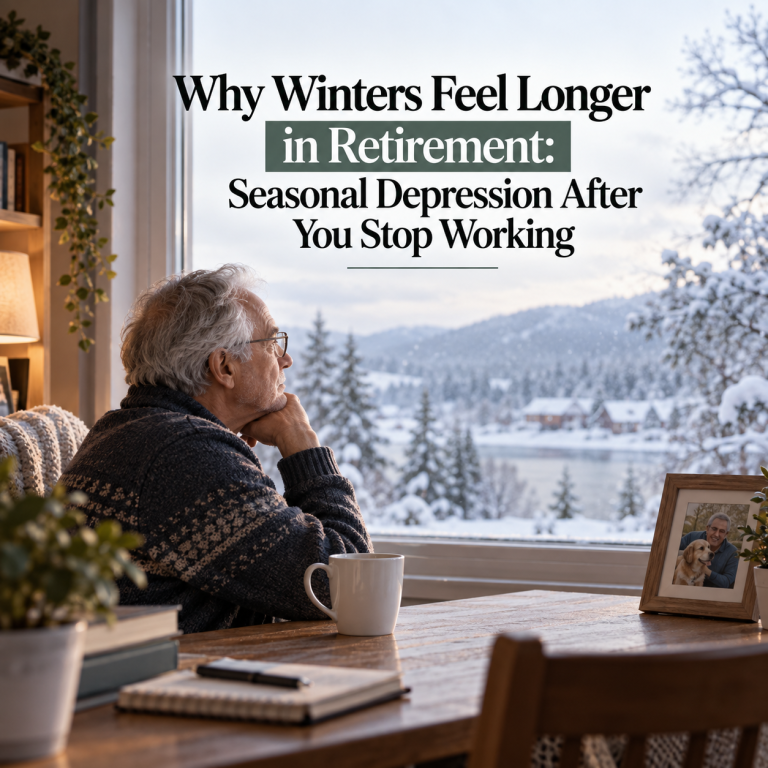
Why Winters Feel Longer in Retirement: Seasonal Depression After You Stop Working

  • Retirement removes two winter buffers at once: the fixed schedule and the daylight exposure that came with going to work.
  • Winter-pattern seasonal affective disorder (SAD) symptoms typically last about 4 to 5 months a year, and rates rise the farther north you live.
  • In one study of older adults, time spent in bright light fell from 46 minutes a day in summer to 3 minutes in winter.
  • Older adults who keep consistent daily routines report less depression, even when their sleep doesn’t improve.
  • Light therapy and CBT tailored for SAD work about equally well in the first winter, but the CBT approach held up better two winters later.
  • In Cyn Meyer’s coaching practice, clients in long, harsh winter climates feel this hardest, and a seasonal cadence of activities is the most effective fix she has seen.
  • Low mood that lasts more than two weeks and disrupts daily life deserves a doctor’s attention.

Winters feel longer in retirement because work used to give you two things that protect your mood in the dark months: a fixed daily schedule and regular time outside. Retirement removes both at once. The fix is to rebuild them on purpose with morning light, a consistent routine, and activities planned for the season. This isn’t a personal failing. It’s a predictable pattern, and predictable problems can be planned for.

This article covers the seasonal slump that starts in fall and lifts in spring. Year-round low mood and general fatigue after retiring are addressed separately below. 

Why Does Winter Feel Harder After Retirement? 

Retirement makes winter harder because it removes the daily structure and incidental daylight that work used to provide. When you were working, winter darkness was inconvenient, but it rarely had the last word. You still got up at a set time. You still commuted, even if it was dark both ways. You still walked to a meeting, crossed a parking lot, or grabbed lunch outside the building. 

None of that was intentional light exposure or structure-building. It just happened, as a byproduct of having somewhere to be.

Retirement removes the “somewhere to be.” Without meaning to, many retirees trade that incidental structure for an open schedule. In winter, that schedule can shrink to the couch, the news, and not much else. The season didn’t get harder. The defenses against it went away.

Is It Winter Blues or Seasonal Affective Disorder?

Not every winter slump is SAD. According to the National Institute of Mental Health, SAD is a type of depression with a recurring seasonal pattern, and its symptoms last about 4 to 5 months per year. Many more people notice a milder seasonal dip that never reaches that level.

Why Winters Feel Longer in Retirement (and What Helps)
Feature Winter Blues Seasonal Affective Disorder
Severity Mild Moderate to severe
Daily life Mostly intact, just harder Noticeably disrupted
Pattern Comes and goes with events and weather Most days, for weeks at a time
Diagnosis Not required Diagnosed by a health professional
Typical response Light, routine, and social contact Professional treatment plus those same habits
NIMH lists several symptoms specific to winter-pattern SAD:
  • Oversleeping
  • Overeating, especially cravings for carbohydrates
  • Weight gain
  • Social withdrawal, sometimes described as feeling like hibernating
These appear alongside general depression symptoms, such as low energy, loss of interest, and trouble concentrating. If tiredness is your main complaint rather than low mood, and it doesn’t follow the seasons, read about what helps post-retirement fatigue. Some people face higher risk. SAD is diagnosed more often in women, and a family history of depression or other mood disorders raises the odds. The distinction matters. A mild seasonal slump usually responds well to the structure and light strategies below. A more severe pattern deserves a conversation with a doctor, not just a light box and a to-do list.

How Much Daylight Do Older Adults Get in Winter?

Older adults get very little bright light in winter, often just minutes a day. Researchers tracked light exposure among 16 care home residents aged 72 to 99 across two seasons. Average morning light fell from 466 lux in summer to 65 lux in winter. Time spent in bright light above 1,000 lux dropped from 46 minutes per day to just 3 minutes.  That’s a small care home sample, not a group of recent retirees. Still, it shows how little bright light older adults receive in winter once nothing pulls them outside. Ordinary indoor lighting sits far below the 10,000 lux used in light therapy. Your brain uses morning light to set its internal clock, the same clock that regulates mood, sleep, and energy. When winter cuts light exposure, and retirement removes the structure that used to force you outside, the effects compound. You get less light, less reason to seek it out, and a body clock that starts running on the wrong schedule.

Why a Consistent Routine Protects Your Mood in Winter

A consistent daily routine helps protect your mood in winter by keeping your body clock steady when daylight can’t. A 2026 University of Missouri study of 67 older adults found that people with consistent daily routines reported less pain and fewer depressive symptoms. That held true regardless of how well they slept. Routine meant regular timing for waking, meals, social contact, and bedtime.  The findings show an association rather than proof that routine alone treats depression. The researchers point to “social jet lag,” the internal clock disruption caused by shifting schedules between weekdays and weekends. Shorter winter days already strain that clock, so an irregular retirement schedule adds a second disruption on top. Second Wind Movement client Danny van Leeuwen built this kind of structure out of necessity. He developed a disciplined daily routine to manage a chronic health condition, then applied the same approach to the rest of his life. His week now includes daily saxophone practice, board service for a national health organization, and regular time with his grandkids. The routine carries him through the hard stretches.
What Deepens the Winter Slump What Shortens It
Sleeping in later with no fixed wake time Same wake time every day, weekends included
Staying indoors until symptoms force a change Bright light exposure first thing, on purpose
Letting the calendar stay empty all winter Scheduling outside time and social contact like appointments
Waiting for spring to feel motivated again Building one small daily habit now, regardless of mood

How Climate and Latitude Change the Picture

Seasonal depression is more common the farther north you live. According to StatPearls clinical guidance, SAD prevalence ranges from about 1% to 10% depending on latitude. A survey across four U.S. locations, from New Hampshire down to Florida, found winter SAD significantly more common at northern latitudes. That northern increase showed up mainly in adults over 35. 

Cyn Meyer sees the same pattern in her coaching practice. Clients in the Upper Midwest, New England, the Great Lakes region, and the mountain states struggle with winter far more than clients in Florida, Arizona, or Southern California, where a winter routine barely has to change.

For retirees in those harder-hit climates, the strategies in this article aren’t optional extras. They can be the difference between a hard four months and a lost season.

Build a Seasonal Cadence of Activities

The single most effective fix Cyn has seen with clients in cold climates isn’t one habit. It’s a seasonal cadence: a rotating menu of activities that changes with the calendar. Instead of forcing summer habits into winter or letting the calendar go empty until spring, you always have something built for the season you’re actually in.

Cold-weather options might include:

  • Indoor golf simulators
  • Downhill or cross-country skiing and snowshoeing
  • Indoor pilates or yoga classes
  • Seasonal one-off classes, such as ice sculpting or a pottery workshop

When the weather turns, the cadence shifts to biking, hiking, kayaking, outdoor yoga, and gardening.

A simple way to build the list is to find a winter version of each summer habit:

Summer Habit Winter Version
Gardening Houseplants, herb windowsill, or planning next year’s beds
Morning walks outside Snowshoeing, a headlamp walk, or mall walking
Golf Indoor golf simulator or putting league
Outdoor yoga Indoor yoga or pilates class
Kayaking or swimming outdoors Indoor pool laps or water aerobics
Patio gatherings A standing weekly lunch or game night
The specific activities matter less than the principle behind them. You’re not waiting out winter until real life resumes in spring. You’re living a full life in every season, just a different version of it. For Cyn’s clients in the toughest climates, that shift from enduring winter to designing for it is often what breaks the cycle. Mapping winter options across the 5 Rings of Retirement keeps the plan balanced. Aim for at least one winter activity each for staying socially connected, protecting your health, continued learning and growth, and giving back to others.

Five Ways to Shrink Your Winter This Year

1. Get Bright Light First Thing, Every Day

Light therapy is a mainstay treatment for winter-pattern SAD. It typically involves sitting near a 10,000 lux light box for about 30 to 45 minutes shortly after waking. If a light box isn’t an option yet, getting outside within the first hour of waking still helps more than staying under room lighting, even on a cloudy day. A few setup details make a difference. Use the box in the morning only, since evening use can disrupt sleep. Place it about an arm’s length away, angled toward your face, while you read or eat breakfast. If the brightness feels like too much at first, start with shorter sessions and build up. Brightening your home helps too. Open blinds first thing, sit near your brightest window during the day, and trim any branches blocking the light. Check with your doctor before starting light therapy, especially if you have:
  • Macular degeneration, glaucoma, cataracts, or other eye conditions
  • Diabetes that affects your eyes
  • Bipolar disorder, since bright light can trigger mania in some people
  • A history of unusually high energy or little need for sleep in spring
  • Medications that increase light sensitivity
Choose a box designed for SAD that filters out UV light.

2. Rebuild One Anchor Routine

You don’t need to recreate your old work schedule. You need one anchor: a consistent wake time, a morning walk, or a standing coffee with a friend. Second Wind Movement client Steve Bram credits “positive daily habits of focusing on myself, my growth, my passions” with aligning his retirement to who he wanted to be. That kind of daily anchor is exactly what protects against the drift winter makes so easy. Protect the evening end of the routine as well. Keep screens out of the last hour before bed, and go easy on alcohol, which can deepen low mood and disrupt sleep.

3. Schedule Outside Time Like You Used to Schedule Meetings

Put it on the calendar at a specific time, ideally in the morning. “I’ll go outside if I feel like it” reliably loses to a dark, cold day. “I walk at 9am” doesn’t ask you to feel like it first. On icy days, move the appointment indoors rather than canceling it. Mall walking, a community center track, or a pool session keeps the habit intact without the fall risk. Short bursts count, too. Two or three 5 to 10 minute movement breaks a day add up, and walking, yoga, and strength training all support mood.

4. Consider CBT for SAD for a Longer-Lasting Result

Cognitive behavioral therapy tailored for seasonal depression (CBT-SAD) teaches skills for changing winter thought patterns and staying active. In a randomized trial of 177 adults, CBT-SAD and light therapy worked about equally well during the first winter. The difference showed up later. In follow-up two winters after treatment, depression returned in 27.3% of the CBT-SAD group compared with 45.6% of the light therapy group. The researchers note that most people never restart light therapy in later winters, which leaves them unprotected. The lesson for retirees is simple. A tool only works if the habit around it lasts. Ask a doctor or therapist whether CBT-SAD, light therapy, or both fit your situation.

5. Don’t Wait for Spring to Make Plans

One of the quiet traps of the winter slump is deciding that real plans, like the trip, the class, or the project, can wait until you feel like yourself again. Reverse it. Make one plan now, small enough to follow through on even on a low-motivation day. Let the momentum from following through help lift the mood, rather than waiting for the mood to lift first.

Other Winter Factors Worth Planning For

Beyond light and routine, four other factors shape how winter feels in retirement: the post-holiday drop, vitamin D levels, ice and shorter driving hours, and whether spending part of the season somewhere warmer is an option. 

The Post-Holiday Drop

For many retirees, January is harder than December. The holidays fill the calendar with visits and events, then everything stops at once. Grief can also surface around the holidays for anyone who has lost a spouse or close friend. Scheduling a few January commitments in advance softens the drop.

Vitamin D

With less sunlight, the body makes less vitamin D, and NIMH lists vitamin D among the treatment approaches for winter-pattern SAD. Aging skin also produces vitamin D less efficiently. Ask your doctor to check your level before taking supplements. The right amount depends on your health and current medications, and too much vitamin D can build up and cause harm.

Ice, Cold, and Shorter Driving Hours

Winter shrinks the calendar in practical ways too. Icy sidewalks raise fall risk, and early sunsets make evening driving harder for many older adults. If driving is becoming a concern, it’s worth building a transportation plan before winter rather than during it.

Spending Part of the Winter Somewhere Warmer

For retirees with the flexibility, spending part of the winter in a sunnier climate is a real option. Even a few weeks can break up the darkest stretch. There are trade-offs to weigh. Time away can loosen ties to your home community, pause routines that took effort to build, and add cost. If you go, carry your anchor routine with you and plan how to stay connected to people back home.

When a Winter Slump Needs Professional Help

A mild slump often eases with light, structure, and social contact. Reach out to a doctor if several of these signs last more than two weeks:
  • Persistent sad, anxious, or empty mood most of the day
  • Loss of interest in nearly everything, not just low energy
  • Sleeping far more or far less than usual
  • Significant changes in appetite or weight
  • Trouble concentrating or making decisions
  • Feelings of hopelessness or worthlessness
A doctor can screen for depression and discuss light therapy, CBT-SAD, medication, or a combination. Medicare covers an annual depression screening in a primary care setting, so it’s worth asking for at your next visit, ideally before winter sets in. If low mood doesn’t follow a seasonal pattern and has been present since you retired, the causes and fixes are different. Start with adjusting to depression after retirement. If thoughts of self-harm come up, call or text 988 to reach the Suicide and Crisis Lifeline at any time.

Your Retirement Winter Planning Calendar

Winter is predictable, which means it can be planned. Use this calendar as a starting point and adjust it to your climate.
When Focus Actions
September and October Prepare Build your winter activity list, ask your doctor about a light box and vitamin D, and request a depression screening
Fall clock change Hold steady Keep the same wake time on the clock and get outdoor light the first few mornings
November and December Look ahead Put a few January commitments on the calendar before the holidays and start tracking mood weekly
January and February Protect the routine Treat this as the peak risk window, keep the anchor routine on gray days, and call your doctor if low mood lasts two weeks
March and April Review Note what worked and what didn’t, shift the cadence outdoors, and save your notes for next fall

Designing a Winter That Holds

Knowing why winter hits harder in retirement is only half the work. A light box used twice or a routine that fades after one good week doesn’t change the season. This is where many people get stuck, and where working with a retirement coach can help.

The pattern is familiar. A good week makes the routine feel less urgent; it quietly slips, and the old defaults return: staying inside, sleeping later, waiting for motivation.

Second Wind Movement’s Rewire My Retirement™ program turns a good intention into a daily habit through the three steps of Cyn Meyer’s Rewire Retirement Method:

  • Gain Clarity on which habits actually protect your mood
  • Engage Micro-Steps that make light and routine a daily practice
  • Build Momentum so the routine holds through the whole season

A good starting point is the free retirement masterclass, How to Turn Your Successful Career Into a Successful Retirement.


Frequently Asked Questions About Seasonal Depression in Retirement

Can you develop seasonal depression for the first time after retiring?

Yes. A work schedule can mask a seasonal pattern for years by forcing daily structure and time outside. Once that schedule ends, a mood dip that was always present in milder form can become much more noticeable.

How is seasonal depression diagnosed?

A doctor or mental health professional usually asks how your mood changes across the year and may use a questionnaire such as the PHQ-9 or the Geriatric Depression Scale. A seasonal pattern generally needs to repeat for at least two years before SAD is diagnosed. Your doctor may also run tests to rule out other causes, such as thyroid problems or medication side effects.

What if my symptoms don’t lift in the spring?

Then it may not be SAD. Depression can start in winter by coincidence and continue year-round, which calls for a different treatment approach. If spring arrives and you still feel low, tell your doctor rather than waiting for summer.

Can seasonal depression happen in summer?

Yes, though it’s less common. Summer-pattern SAD tends to bring trouble sleeping, poor appetite, weight loss, restlessness, and anxiety, which is nearly the opposite of the winter pattern.

Does starting light therapy early in the fall prevent seasonal depression?

Opinions differ. Some clinicians recommend starting light therapy and fall routines early, while NIMH reports no convincing evidence that starting treatment ahead of time prevents an episode. Either way, having a light box and routine ready in early fall means you can respond quickly when the first symptoms appear.

Can antidepressants help with seasonal depression?

Yes. NIMH lists antidepressant medication as one of the main treatment categories for SAD, and bupropion XL is one option doctors use specifically for seasonal depression. Most antidepressants take around two weeks to show early effects, so a doctor will usually adjust the plan over several weeks.

Is it normal to feel down every winter?

Seasonal mood changes are common, but recurring symptoms that disrupt daily life aren’t something you simply have to live with. If the same slump returns every year, it’s worth discussing with a doctor before the next fall arrives.


What's Your Retirement Purpose?

These 10 questions can make all the difference
portrait of Cyn Meyer, founder of Second Wind Movement and a certified retirement life coach
Cyn Meyer 

Retirement Life Coach

As a certified retirement life coach since 2018, Cyn has helped thousands of older adults turn their retirement years into remarkable years full of growth, purpose, and passion. Through her signature program Rewire My Retirement, she helps people achieve their best life across the 5 Rings of Retirement, which covers topics Growth, Community, Health, Giving Back, and Finance.


Cyn combines specific life coaching tools, neuroscience, and her extensive background in marketing (spanning 17 years) to make a powerful impact with Second Wind Movement – an organization dedicated to providing educational resources and coaching for seniors.

With meticulous research, insight, and passion, Cyn’s mission is to usher in a new wave of positive experiences for generations of retirees.

portrait of Cyn Meyer, founder of Second Wind Movement and a certified retirement life coach

Cyn Meyer 

Retirement Life Coach

As a certified retirement life coach since 2018, Cyn has helped thousands of older adults turn their retirement years into remarkable years full of growth, purpose, and passion (beyond the stereotypical financial planning side of retirement). 

She combines specific life coaching tools, neuroscience, and her extensive background in marketing (spanning 17 years) to make a powerful impact with Second Wind Movement – an organization dedicated to providing educational resources and coaching for seniors.

With meticulous research, insight, and passion, Cyn’s mission is to usher in a new wave of positive experiences for generations of retirees.