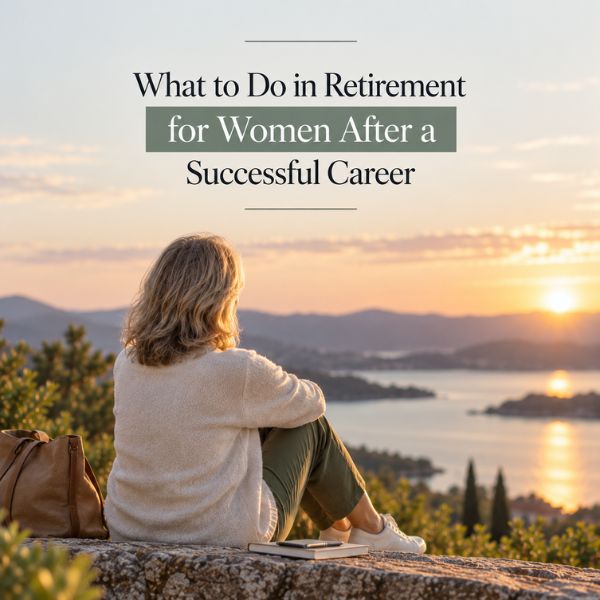
- The best thing to do in retirement after a successful career is to redirect ambition and skills into new channels, not shelve them. Encore work, board leadership, mentoring, creative projects, deeper relationships, and intentional physical health all count.
- Retirement doesn’t automatically hand women the same satisfaction boost it hands men, according to an NBER analysis of retirement and well-being, which means building a fulfilling next chapter takes more deliberate design for women than the “just relax” narrative suggests.
- Women volunteer at meaningfully higher rates than men, roughly 31% versus 26% in the most recent AmeriCorps civic engagement data, so channeling energy into a cause is one of the fastest paths to renewed purpose.
- Starting or buying a business later in life is increasingly common among women leaving a long-term career, not a fringe choice.
- Without the built-in structure of a career, women’s health habits can slip fast. The same NBER research found notable gaps in physical activity after retirement, making it a priority to build movement into the day, not an afterthought.
- Working part time after retirement has real limits worth knowing before committing to a paid direction, particularly around Social Security.
- A six-month plan isn’t required to start. One direction and one small action this week is enough.
The most valuable thing a woman can do in retirement after a successful career is redirect her ambition, skills, and follow-through into a new direction, not set them aside. In practice, that means choosing one direction: encore consulting, board or nonprofit leadership, mentoring, a shelved creative project, deepened relationships, physical reinvention, lifelong learning, or civic advocacy. The next step is building it with the same intentionality that built the career. The job title retires. The ambition, skills, and follow-through do not. They just need a new place to go.
What a Career Really Gave You, and How to Rebuild It in Retirement
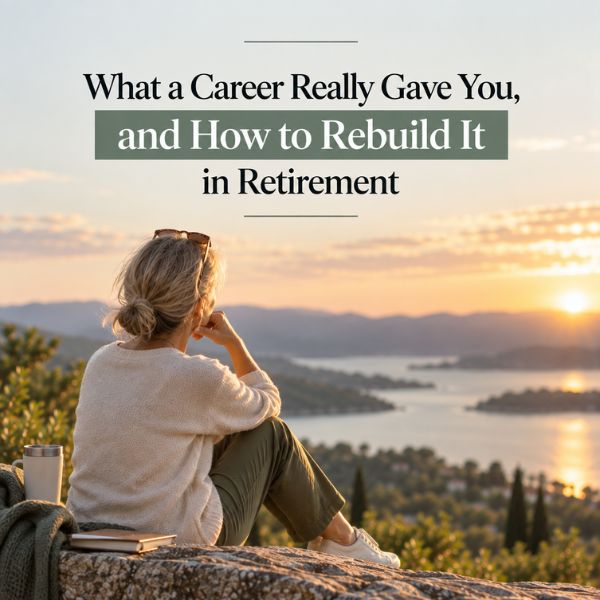
Much well-meaning retirement advice misses the mark for successful women. It treats retirement like a finish line, something to relax into: take up a hobby, read more, travel a little.
For decades, these women led teams, ran households and careers at the same time, and solved problems for a living. That kind of advice can feel like being asked to shrink. A demanding career provides more than a paycheck. It provides:
- Structure: a schedule and a reason to plan each day
- Community: a network of people who rely on you
- Motion: a sense of forward progress toward something
- Worth: daily proof that the work matters to something bigger than one person
Losing all four at once turns “just relax” into a void rather than a plan, which is why retirement feels harder for women after a demanding career. This isn’t about filling time. It’s about rebuilding structure, community, motion, and worth, on new terms, and about the actual directions women channel that energy into.
The Research: Retirement Doesn't Automatically Improve Life Satisfaction for Women
This pattern is backed by research, not just observation.
- The National Bureau of Economic Research analysis on subjective well-being found that men experience a meaningful jump in life satisfaction after retirement, about a 10% improvement. Women, on the same measure, showed no statistically significant change.
- The same National Bureau of Economic Research analysis found that after retirement, men increased their physical activity, while women did not show the same increase, and other health markers moved in the wrong direction.
The takeaway is that retirement doesn’t automatically make life better for women the way it tends to for men. It has to be built on purpose, with the same intentionality that built a career. That’s genuinely good news. It means the outcome is within a woman’s control, not left to chance.
8 Things Women Can Do in Retirement After a Successful Career
The skills that built a successful career, project management, leadership, deep expertise, follow-through, decades of relationship-building, can point somewhere new. Eight directions show up again and again.
1. Encore Work or Consulting
Not the old job, a new version of it.
- Advising or freelance consulting in the same field
- A part-time role that uses existing expertise without the grind of the old schedule
- Fractional or project-based work that keeps a professional identity active
2. Board Seats and Nonprofit Leadership
Organizations actively look for people with exactly this kind of background.
- Budgeting and financial oversight experience
- Strategic planning and team leadership
- Committee or board work that keeps a sharp professional mind engaged while serving a cause that matters
3. Teaching, Coaching, and Mentoring
Decades of hard-won knowledge is valuable to someone earlier on the same path.
- Formal mentoring programs in a former industry
- Teaching a class, in person or online
- Informally coaching younger women in the same field
4. Creative Projects Shelved for Decades
The book. The art. The business idea that never had room in a full calendar.
Cyn’s client Sue Camaione had a memoir manuscript stuck at 75% completion for years while she worked. Once she gained clarity on her post-career direction, she finished it, published it on Amazon and Barnes & Noble, and had two more books’ worth of ideas waiting behind it.
5. Deepening the Relationships a Career Crowded Out
Cyn’s client Donna, a career and family woman who felt an unexpected void after retiring, slowly rebuilt her days around guitar practice, poetry, daily meditation, and reconnecting with her daughter and extended family, and found new love along the way. None of that happened by accident. It happened because she got intentional about where her time went.
6. Physical Reinvention
Cyn’s client Paulett, a longtime teacher, built an entire new rhythm around teaching chair yoga and hosting online yoga classes from home, turning movement into both a health practice and a new sense of purpose.
7. Formal Education and Lifelong Learning
Going back to school doesn’t require a full degree program to count.
- A certification or credential in a subject that was always a side interest during the working years
- A structured online course with real deadlines and a cohort, rather than passive video-watching
- Language learning, an instrument, or another skill that takes sustained, deliberate effort
Cyn’s client AnnaBelle Marshall, who joined the program at 92, is proof this direction has no age ceiling. Allowing herself to learn something new was, in her words, what turned an ordinary stretch of retirement into an extraordinary one.
8. Advocacy, Public Speaking, or Civic Leadership
Board work is governance from the inside. This direction is about using a professional voice publicly.
- Testifying or providing public comment on issues tied to a former field of expertise
- Speaking at conferences, community events, or industry gatherings as a subject-matter voice rather than a company representative
- Running for or serving on a local commission, school board, or civic body where professional judgment translates directly
What These Directions Cost, and How to Fund the Transition
Not every direction requires new money, but a few decisions are worth making before committing time or savings to any of them.
- Board seats, mentoring, and most volunteer roles carry little to no financial cost. They draw on time and expertise that already exist.
- Encore consulting or part-time work can act as a funding bridge for other pursuits, supplementing retirement income while keeping a professional identity active.
- A creative project or a small business often carries real costs. Consulting or advisory work can often start for the price of a website and business cards, while a product-based business or franchise typically requires meaningfully more upfront capital.
- Before committing, it’s worth reviewing how the expense fits the broader retirement budget rather than treating it as a side project with no financial footprint.
Two details are easy to overlook and worth checking before saying yes to paid work in retirement:
- Social Security has an earnings limit for anyone collecting benefits before full retirement age. According to the Social Security Administration, the 2026 limit is $24,480 for those under full retirement age all year, and $65,160 for those reaching full retirement age during the year, with $1 in benefits withheld for every $2 or $3 earned above those limits respectively. Once full retirement age is reached, the limit disappears entirely.
- Consulting or freelance income is typically self-employment income, which carries its own tax treatment separate from a W-2 paycheck. It is worth a short conversation with an accountant before the first invoice goes out, not after.
A short review of retirement finance planning before starting any paid venture can clarify two things. First, how much income the new direction actually needs to generate, if any. Second, how a new expense or income stream affects the existing retirement plan.
The Health Piece Nobody Warns Successful Women About
The structure a career gave the body, the commute that got a woman moving, the standing meetings, the reason to get dressed and leave the house, disappears along with everything else. That’s part of why the research above showed women’s activity levels stalling after retirement while other health markers moved the wrong direction.
The fix isn’t a dramatic overhaul. It’s rebuilding movement and mental engagement into the day with the same deliberateness that once went into a calendar full of meetings.
4 Steps to Build Movement Back Into Your Days
- Pick one time of day and protect it for movement, the same way meetings were once protected on a work calendar. A scheduled commitment tied to a specific time recreates the accountability a work calendar used to provide.
- Find one class, walking group, or activity partner so the habit is social, not solitary; this also helps rebuild the community piece covered below.
- Pair physical movement with something mentally demanding, a language, an instrument, a skill tied to one of the eight directions above, since cognitive engagement and physical activity reinforce each other.
- Track it for 30 days, not for perfection, just for consistency. Momentum matters more than intensity here.
Staying Connected: Beyond the Workplace, Beyond Old Roles
A career often provides a built-in social circle. Once that circle disappears, rebuilding connection has to become its own priority rather than something that happens on its own.
- Volunteering is one of the fastest paths to both purpose and connection at once. Women have volunteered at meaningfully higher rates than men for two decades running. An analysis of the 2023 Current Population Survey found about a quarter of men and almost 3 in 10 women volunteered in the past year. A cause-based commitment is a natural first step for many women leaving a career.
- Board work and mentoring, both covered above, put a woman in regular contact with people working toward something she cares about, which rebuilds community the same way a workplace once did.
Real Cases: Three Dynamics Coaching Reveals
Three dynamics come up often in Cyn’s coaching practice that rarely get named directly.
The first is caregiving. Cyn’s client Joyce Miller had already retired when her son became quadriplegic, and she spent years as his full-time caregiver. After he died, she was left with grief and no retirement plan to fall back on. Through the Rewire Retirement Method, she sold her home of 30 years, relocated, and built a new routine around exercise, volunteering, and new friendships. Caregiving can quietly absorb the time meant for a new direction, so a retirement plan needs room for it.
The second is rebuilding a social life that was never really “hers.” Cyn’s client Mary Zimmerman was widowed at 59, and her social circle had always been built around her more outgoing husband. Rebuilding meant becoming the one to reach out: moving to a coastal neighborhood she loved, joining a travel club, taking weekly Zumba classes, and picking up part-time work.
The third is the marriage or partnership itself, when both people are still present. Retirement often means far more time together than ever before, and that shift isn’t automatic. Cyn’s client Paulett Amburn, who also teaches chair yoga, has said that becoming more self-confident and consistent through the process improved her relationship with her husband directly, not as a separate project.
The goal isn’t to replace every work friendship one for one. It’s to make sure at least one or two regular touchpoints exist that aren’t left to chance. Caregiving, an inherited social circle, or an unexamined marriage dynamic shouldn’t quietly stand in for a direction a woman actually chose for herself.
Your First 90 Days in Retirement: A Week-by-Week Plan for Career Women
Rather than a checklist to tackle all at once, here’s how to sequence the first 90 days so the directions above actually take hold.
- Days 1 to 14: Observe before you commit. Track how you’re actually spending your time and energy each day, without picking a direction yet. Note which hours feel alive and which feel empty. This window exists specifically so a direction gets chosen from real data about your days, not from whichever idea sounds best on paper.
- Days 15 to 30: Pick one direction and make it real. Choose a single direction, then take one concrete, visible action toward it: an email sent, a class booked, a first page written. Tell three to five specific people what you’re doing, by name, this week, not “eventually.”
- Days 31 to 60: Build the routine around it. Attach the new direction to a fixed time on the calendar, the same way a work commitment once had a fixed time. Layer in one physically or mentally demanding habit alongside it, since a direction without a routine tends to fade by week six.
- Days 61 to 90: Review, adjust, and set the next 90. Sit down and answer three questions honestly: what’s working, what’s quietly being crowded out by someone else’s needs, and what would you change if you started over today. Use the answers to set the next 90 days rather than defaulting into whatever routine happened to form.
Why a List Alone Won't Change Anything
Reading a list of eight directions accomplishes little on its own. Someone has to pick one and follow through. The real shift happens when “that one sounds right” turns into consistent daily action.
This is where most women get stuck. A list like this sparks a moment of clarity about which direction fits, and then life gets in the way. Procrastination creeps in. Decision fatigue takes over. An achievement-driven mind that used to run on external deadlines has no deadline now. The project quietly stalls. The old default, staying busy without a real direction, takes over again.
Turning a spark of clarity into a real, lived routine takes a system, not more willpower. The Rewire Retirement Method was built to be that system.
The Rewire Retirement Method
This is exactly what the Rewire Retirement Method, created by Cyn Meyer, is designed to do. It works in three steps.
- Gain Clarity through daily inward reflection, to identify precisely which direction is genuinely right, not just the one that sounds good on paper
- Engage Micro-Steps through focused outward action, so the small weekly action from the 90-day playbook actually happens, week after week
- Build Momentum by structuring the new direction into daily life from day one, so it becomes a new normal instead of another good idea that fades
Those three steps get applied across the 5 Rings of Retirement: Growth, Community, Health, Giving Back, and Finance, so no single area gets left behind
Ready to Build a Personal Retirement Playbook With Expert Guidance
Redirecting ambition into a real plan takes more than a list of ideas. It takes genuine clarity on which direction actually fits, a system for building momentum without burning out, and often a second set of eyes to catch what’s hard to see from inside the transition.
Second Wind Movement’s free masterclass, How to Turn a Successful Career Into a Successful Retirement, walks through the same clarity and momentum framework covered in this guide. For women who want that framework applied directly to their own career, family, and circumstances, working one-on-one with a certified retirement life coach turns this guide from something to read into a plan that actually gets built and followed through.
Frequently Asked Questions About Retirement for Women After a Successful Career
How do I know if I’m ready to retire from a demanding career?
Readiness often looks like fatigue that rest doesn’t fix, or already picturing life beyond the role. Having even a rough idea of what to do with the time, beyond travel and rest, is a stronger signal than certainty. Some uncertainty about the details is normal and not a reason to wait indefinitely.
What if my spouse or partner is still working?
A staggered retirement timeline is common and workable. The retired partner benefits from building an independent direction rather than waiting for shared free time. A short conversation about daily logistics, like meals and quiet hours, heads off friction before it starts.
Is it selfish to prioritize myself after years of career and caregiving?
No. Decades spent meeting other people’s needs, whether through a demanding job or family caregiving, don’t disqualify a woman from building something for herself now. Calling it selfish usually reflects an old habit of putting herself last, not an accurate read of what she’s earned.
How is retirement different for women who never had children?
Without children or grandchildren nearby, rebuilding community tends to lean more on peer groups, volunteer work, and professional networks rather than family gatherings. The underlying task, replacing structure and connection, stays the same, but the sources look different.
What if my friends are still working?
A gap in daily availability is common when friends retire on different timelines. Daytime classes, volunteer shifts, or a new peer group built around a shared interest tend to fill that gap faster than waiting for existing friends to catch up.
Do I need a strict daily schedule, or is flexibility healthier?
Some structure matters early on, since an empty calendar is usually where drift starts. Once a direction is established and running on its own momentum, that structure can loosen without the routine falling apart.