There’s so much proof behind why your morning routine is so important. As I researched this topic, I found most of the info out there about the impact of morning routines to be targeted toward business-minded people who are working towards peak career success.That’s great and all, but what about older adults and the people who are having trouble making the big transition into retired life? If you’re familiar with my content, you may know that I’m anti-leisure-only, when it comes to the traditional sense of retirement. No longer is retirement life about simply sitting around and living a life of leisure, which is what most retirees figure out in the reorientation retirement stage.And on the topic of stages, as Dr. Ken Dychtwald of Age Wage suggests, life doesn’t happen in three clean separate stages but it happens instead in intermingled cyclical stages:Retirement life is not just about leisurePlus, winding down your learning activities and your sense of productivity and adventure is not something that’ll help build up your neuroplasticity. In fact, unleashing your sense of adventure and creativity is hugely important, especially for older adults. Especially if you want to age successfully in place. Without further ado, here are 6 reasons (and benefits) of having a morning routine.
6 Reasons Why Having a Morning Routine Works
It’s important to tackle every day with intention, energy and purpose, so you can increase your longevity and keep your cognitive health strong. I’ve broken it down into these six reasons why having a healthy morning routine can springboard your life into a very meaningful, productive, healthy, and purposeful retired life.Without further ado, here’s why a good morning routine works:
#1: Your Mood = Your Productivity Level
According to research from Ohio State University, your mood in the morning dictates how productive you are that day. The study found that:
“employee mood had a clear impact on performance, including both how much work employees did and how well they did it.”
If you pull it out of the working environment context and apply it to how productive you are in your personal life, this perspective shift can really help you shake up your life… in a great way. What’s your typical mood in the mornings? Source: GiphyOnce you can get your morning right, you get your day right, and… you get your life right. You’ll make progress on things that actually matter to you, and you’ll likely be energized doing it.Sounds simple enough, right?But, of course, it isn’t the easiest thing to do. The trick will be in creating a consistent routine that you use repeatedly. Basically, you need to replace your current non-impactful habits with healthy habits.
#2: Allows Space for Setting the Tone
By giving yourself the mental and physical space to set the tone for the day, you get to choose how to manage your emotions in the morning. Instead of waking up and reacting to whatever mood you’re in after a night’s slumber, a consistent morning routine gets you in the habit of being more proactive and intentional.This works wonders for your mindest. I highly recommend practicing gratitude and incorporating mindfulness into your morning ritual, too. It’s a solid way to set yourself up with the right tone for the day.(By the way, if you have trouble getting restful sleep at night, here are some effective sleep tips to help you through the night.)The important takeaway is to allow yourself the space to set the right tone. By giving yourself the time to be aware of your mood, you’ll better manage how you actually want it to be throughout the day.Then reason #1 will kick in, with your mood dictating how productive you’ll be.
#3: Your Willpower is Strongest in the Morning
Another reason why your morning routine is so powerful: your willpower is highest in the morning, right after you sleep, and it gets used up and depleted throughout the day. According to a Stanford Medicine article:
“The research also shows that willpower decreases over the course of the day, as your energy gets ‘spent’ on stress and self-control. This has become known as ‘the muscle model’ of willpower. Like your biceps or quadriceps the willpower ‘muscle’ can get exhausted from effort.”
And it’s also important to follow your natural circadian rhythm. The story according to Steve Kay, a professor of molecular and computational biology at the University of Southern California, goes like this:
“Disruption of circadian rhythms has been linked to such problems as diabetes, depression, dementia and obesity.”
Tip: To increase your willpower strength, meditation and exercise are two activities that can help build up grey matter in your prefrontal cortex. This is the decision-making part of your brain. What’s more, it’ll increase your ability to make better choices throughout the day, also increasing your willpower. Bonus Tip: If you have the time, use your willpower strength in your morning routine to work on something challenging. Whether it’s an exercise routine, healthy eating habit, or even a lifelong learning activity, leverage your willpower with intention.It’s also worth using up your morning willpower on a challenging activity that gets you closer to your most important goals.
#4: Builds Self-Discipline
Doing something consistently every day can build up your confidence, energy level and your self-discipline. I’ve read that it oftentimes doesn’t even matter what’s in your morning routine, and what matters is that you have one.And according to Jocko Willink, who wrote Discipline Equals Freedom: Field Manual, self-discipline is the path to freedom. In his 20-year Navy SEAL experience, Willink used self-discipline to rise through the rank. He become commander of Task Unit Bruiser, the top Special Operations Unit of the Iraq War. Upon his return to civilian life, he used his learned self-discipline habit to create a multi-million dollar career in leadership and consulting. To give yourself the freedom of achieving your lifestyle goals, you can use your morning routine as a consistent and reliable practice that will help build your self-discipline.With that increased self-discipline, you’ll have a much better time achieving your goals… all good things when it comes to successful aging.
#5: Routines and habits run our lives
At least 40% of human behavior is made up of habits (The World Counts).What’s more, a study by Phillippa Lally at the University College London shows us that habits are formed, on average, in 66 days. They can take anywhere from 18 to 254 days to form. Author of The Power of Habit, Charles Duhigg, outlines a three-step loop that happens when we create habits:
Cue – a trigger that tells your brain when and which habit to use
Routine – an activity, emotion or behavior
Reward – how your brain determines if a loop is good for you or not
So, building on reason #4, being repeatedly self-disciplined in your healthy morning routine helps you create good habits. And not just the habit of a morning routine. You’re literally rewiring your brain to tackle habits differently. It’s all about cueing the right trigger and the right reward. Because of the intention you set with your conscious brain, your morning routine can help create some of your best results.Otherwise, some of your bad habits might just stick around.What are some of your bad habits that you can replace? Source: GiphyTip: As part of your morning ritual, make a commitment to yourself to take one important micro-step on a meaningful activity or project. Do this consistently for 30 days and watch the magic happen (and then tell me about, so we can all be inspired).
#6: Builds momentum
Your morning routine can help you build momentum and keep up your well-being over the long-term. When you consider the endowment effect, you’re more willing to invest in something that you already have. So, if you’re starting your day off right, and you’re already moving forward, you’re that much more likely to keep doing positive things throughout the day.Pretty naturally sweet, right?The main takeaway is to establish positive momentum early on to carry it out throughout your whole day, which can snowball into you making larger goals for yourself.Conversely, the opposite can happen so be sure to tap into your mindfulness practices and focus on the idea of replacing your bad habits with good ones. That’ll help you not only in chasing your goals but also in getting over roadblocks.Here’s an extra tip: Your morning routine doesn’t have to be complex. It just needs to be consistent and set the right intentions for your day. Check out these morning routine ideas to find one that’s effective for you.
The Powerful Benefits of a Morning Routine
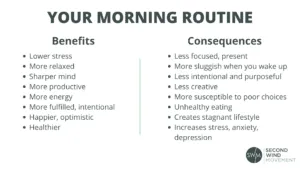
Now that you have six reasons why your morning routine is everything (and the benefits of having one), it should be clear that it plays such a big role in how live your daily life.You likely either have healthy or unhealthy habits in your morning routineTo sum up the benefits of having a morning routine for you, some side effects that you may experience once you establish it:
And some consequences to consider to push you to take action:
Less focused, present
More sluggish when you wake up
Less intentional, less purposeful
Less creative
More susceptible to poor choices
Unhealthy eating
Creates stagnant lifestyle
Increased stress, anxiety, depression
Are you ready to switch it up and commit to a healthy morning routine that fits nicely into your daily life?
P.S. If you’d like to create more than a morning routine, check out our article on creating a daily retirement routineand an evening routine that works for you.
Because mornings set the tone. The way you start shapes how you carry yourself through the hours that follow. A calm, intentional routine can lower stress, boost energy, and make it easier to focus on what matters most.
It doesn’t have to be complicated. Whether it’s stretching, journaling, or enjoying coffee without rushing, those first moments create momentum. Instead of feeling pulled along by the day, you’re leading it, and that small shift can change everything. Not to mention that older adults (yes, especially older adults), perform better in the morning.
Keep it simple. Try to wake up around the same time every day. Add in a little movement, some water, and a nourishing breakfast to set a positive tone.
Mindful practices – like journaling, reading, or a few minutes of quiet – also go a long way. The best routine isn’t about doing everything, it’s about starting with small habits that make you feel good and grounded.
A steady morning routine does more than start your day smoothly, it sets the stage for your mental well-being. Research shows that older adults who wake up consistently and stay active report feeling happier and more balanced.
It also sharpens focus. Those same adults performed better on cognitive tests than people with irregular daily rhythms. The takeaway? A simple, reliable routine helps clear mental fog, boost mood, and give your brain the steady energy it needs to thrive.
Try not to dive straight into stress – checking emails or scrolling the news right away can set an anxious tone for the rest of the day. Give yourself a few calm moments to wake up gently.
And yes, most of us feel like we need that jolt from coffee to function. Just don’t do it first thing. Research shows that waiting until after breakfast helps with better blood sugar control.
The key is to go smaller than you think. Research suggests it takes about 66 days to form a habit and just 7 days of repetition to start rewiring behavior – but only if it feels realistic.
That’s where micro-steps come in. Studies show that when you shrink a habit to its tiniest form (just 2 minutes a day) you lower resistance and make it easier to stick with. Over time, those small, doable steps stack up into lasting change.
As a certified retirement life coach since 2018, Cyn has helped thousands of older adults turn their retirement years into remarkable years full of growth, purpose, and passion. Through her signature program Rewire My Retirement, she helps people achieve their best life across the 5 Rings of Retirement, which covers topics Growth, Community, Health, Giving Back, and Finance.
Cyn combines specific life coaching tools, neuroscience, and her extensive background in marketing (spanning 17 years) to make a powerful impact with Second Wind Movement – an organization dedicated to providing educational resources and coaching for seniors.
With meticulous research, insight, and passion, Cyn’s mission is to usher in a new wave of positive experiences for generations of retirees.
As a certified retirement life coach since 2018, Cyn has helped thousands of older adults turn their retirement years into remarkable years full of growth, purpose, and passion (beyond the stereotypical financial planning side of retirement).
She combines specific life coaching tools, neuroscience, and her extensive background in marketing (spanning 17 years) to make a powerful impact with Second Wind Movement – an organization dedicated to providing educational resources and coaching for seniors.
With meticulous research, insight, and passion, Cyn’s mission is to usher in a new wave of positive experiences for generations of retirees.