Key Takeaways
There’s no single right answer for a LinkedIn profile after retirement. The right move depends on whether the goal is stepping back, staying lightly visible, or actively pursuing consulting, board work, or advisory roles.
Deleting a LinkedIn account outright is usually the wrong first move, even for someone who wants to fully step back. A better first step protects both privacy and the option to reconnect later.
One in three job seekers over 50 report experiencing ageism in their search, according to an iHire survey. A frozen or deleted profile quietly reinforces the “you’re done contributing” assumption instead of challenging it.
Retirement and “done working” aren’t always the same thing. AARP’s own research found that a meaningful share of retirees eventually return to some form of paid work, often for the sense of purpose it provides, not just the income.
Reported losses to employment scams have jumped more than fivefold since 2020, according to the FTC, and retirees are a frequent target regardless of which path applies here.
A headline should describe who someone is becoming, not just archive who they used to be.
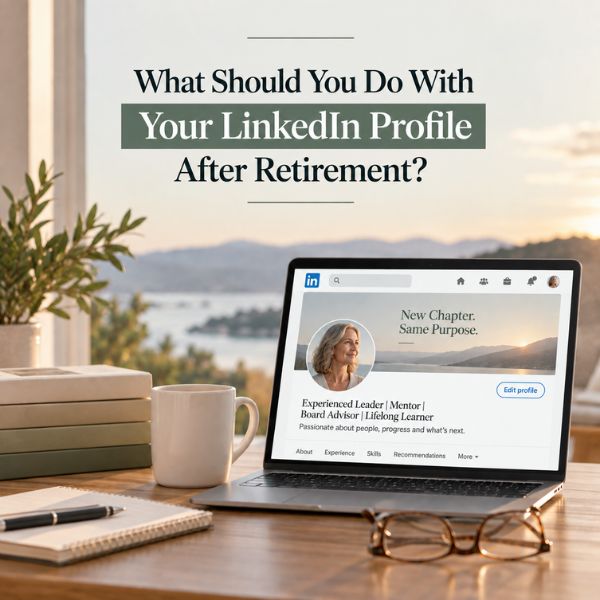
A retired LinkedIn profile isn’t a museum exhibit. It’s a living reflection of the next chapter, and keeping it that way takes far less time than most people assume.
A LinkedIn profile should be updated after retirement, not deleted. The right update depends on what the profile is actually for now: staying quietly reachable, staying lightly visible, or actively pursuing consulting, board work, or advisory roles. That decision comes first, before any headline gets rewritten. Skipping it is where most advice about LinkedIn and retirement goes wrong.
The Instinct to Delete It Is Understandable, and Also Outdated Thinking
The impulse to delete makes sense. LinkedIn feels tied to the career. The career is over. So the logic goes: delete the account, close the chapter, move on.
That logic comes from an old retirement playbook, the one that says a person’s value was their job title, and once the title is gone, so is the reason to stay visible. It doesn’t hold up. Expertise doesn’t retire. Judgment, relationships, and decades of pattern recognition in an industry don’t expire the day paperwork gets processed, and staying connected to people carries real benefits well beyond LinkedIn itself: social interaction has documented cognitive and health benefits as people age.
Deleting a profile is an identity decision, not a logistics decision, and it’s usually made in the first disoriented weeks of retirement, before there’s been any real time to gain clarity on what the next chapter actually looks like. That’s exactly the wrong moment to make it permanent.
First, Decide What the Profile Is Actually For Now
Three goals cover almost everyone facing this decision, and the right actions for one can work against another.
- Step back. The goal is minimal visibility: staying reachable for genuine personal contacts without inviting recruiter messages or unsolicited outreach.
- Stay lightly visible. The goal is preserving the professional network built over a career without actively pursuing anything new.
- Pursue encore work. The goal is generating inbound interest for consulting, board seats, advisory roles, or mentoring. This is the only one of the three that calls for a full profile rebuild.
What follows is organized by which goal actually applies, but two things below are worth doing no matter which path fits.
Two Things Worth Doing No Matter the Path
Move Contact Information Before Work Access Disappears
One detail gets missed constantly on every path: many profiles still list a work email or a phone number tied to systems that stop working the moment employment ends. Before that access disappears, update the contact info section with a personal email and confirm the login itself isn’t tied to a soon-to-be-defunct company address. Losing access to the account entirely, with no way to reset a password, is a far bigger headache than the five minutes this takes to fix.
Watch for Scams That Increasingly Target Retirees
According to the Federal Trade Commission, reported losses to job and employment scams jumped from $90 million in 2020 to $501 million in 2024, and scammers increasingly reach targets through social platforms rather than email alone. A dormant, unattended profile is actually easier to impersonate and harder to notice if it gets compromised or copied, which is why this matters even for someone stepping all the way back.
A few habits close most of the risk. Never send money or personal financial details to anyone met through a LinkedIn message, no matter how polished the offer looks. Verify an unfamiliar recruiter independently, through the company’s own website or a direct call, before sharing anything beyond a resume. Be especially cautious of “board opportunities” or paid consulting offers that ask for banking information before any real conversation has happened. Genuine opportunities don’t require payment or sensitive financial details to get started.
If the Goal Is to Step Back: A Practical Path
Even someone who wants out entirely is better served by a short, deliberate process than an immediate deletion.
- Request a personal data archive before changing anything. This preserves a full record of connections and messages, and it often turns up contacts worth reaching out to before the account changes at all.
- Update the headline to something accurate and low-key. Retired and reachable for personal contacts is enough; there’s no need to overexplain.
- Turn off public profile visibility so the account no longer surfaces in general web searches, while remaining visible to direct connections.
- Use LinkedIn’s hibernation option rather than a full account deletion. A hibernated account can be reactivated later; a deleted one generally cannot. Waiting a full year before closing an account permanently leaves room to change course.
What the Data Actually Says About Staying Visible
For the two paths that involve staying visible, a few things are worth grounding in real research rather than opinion.
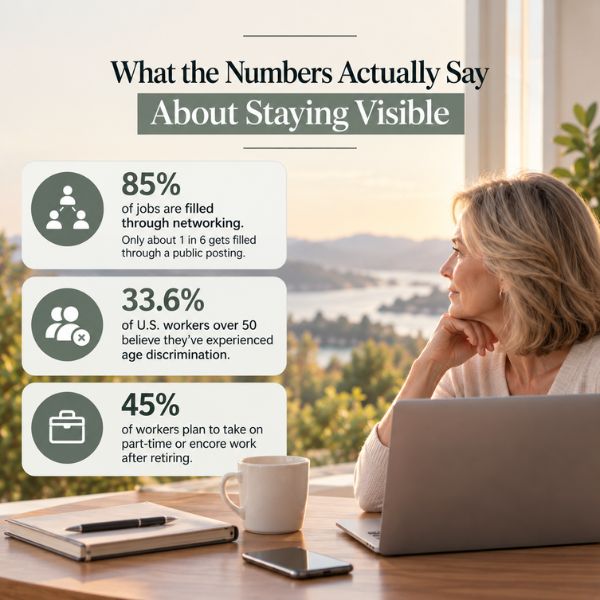
Ageism is a documented, real headwind in the job market. An August 2023 iHire survey of nearly 1,500 workers over 50 found that 33.6% believe they’ve experienced age discrimination in their job search, and over half of that group said a younger, equally or less qualified candidate was chosen instead. A blank or abandoned LinkedIn profile doesn’t fight that bias. It feeds it by making age the only thing left to judge.
And retirement and “done working” aren’t always the same thing. AARP’s own research on retirees returning to work found that roughly 7% of retirees had re-entered the labor force within a recent six-month period. Financial pressure was the most common driver, but staying active and avoiding isolation were close behind. If part of a “best next chapter” ends up including consulting, board work, teaching, or advising, an active LinkedIn profile is often the front door for exactly that.
| Old Way | Rewired Way |
|---|---|
|
Delete the profile the week of retirement |
Update the headline and About section, then leave it live |
|
Headline frozen on the last job title |
Headline reflects who the person is becoming |
|
A profile photo from years and several haircuts ago |
A current photo that actually looks like the person today |
|
Silent, invisible, off the grid |
Occasional posts or comments that keep the profile findable |
|
Waiting to be discovered |
Actively signaling what’s genuinely welcome next |
What to Actually Update on the Profile
For the two paths that call for staying visible, a full overhaul isn’t necessary. About twenty focused minutes and six specific spots cover it.
The Headline
“Retired [Old Title]” tells people what stopped, not what’s available now. Compare “Retired VP of Operations” with “Former VP of Operations | Manufacturing Advisor | Open to Board & Consulting Work.” The first tells a reader nothing to act on. The second gives three reasons to click through and one clear reason to reach out. Mobile screens also truncate headlines after roughly 60 to 80 characters, so the most important words belong at the very start, not buried after a long list of past titles.
The About Section
This is where the career connects to the current chapter, in the person’s own words, written like an actual conversation rather than a resume recap. A short story of where they’ve been and what they’re building toward does more work than a list of titles. Graduation years and exact ages are worth leaving out of this section entirely; a degree or credential still matters, but the year it was earned mainly gives age bias something specific to grab onto.
The Photo and Banner
A photo more than a few years old is worth replacing. The banner image is free real estate that can point to whatever’s current: an organization served, a cause that matters, a project underway.
The Featured Section
Pinning a recent article, a talk given, a board seat, or a current project signals ongoing engagement far more effectively than an empty section ever could.
Skills and Recommendations
The skills section is worth reordering to lead with leadership, strategy, and industry expertise rather than software or tools no longer used day to day. Recommendations carry real weight for consulting or board credibility, and the best time to request one is right around the transition, while a former colleague or direct report still has the working relationship fresh in mind. A simple, direct ask works: mentioning the move toward consulting or advisory work and requesting a short recommendation, with an offer to write one in return.
The “Open To” Setting
LinkedIn allows a person to specify openness to consulting, board roles, volunteering, or speaking, visible only to chosen audiences. Left unset, it does no signaling at all.
Groups and Alumni Networks
Beyond individual posts and comments, LinkedIn Groups tied to a former industry or university alumni network offer a lower-effort way to stay part of ongoing conversations. Membership alone keeps a profile appearing in a wider set of searches, and occasional participation in group discussions reaches people who never would have seen an individual post.
LinkedIn connection is a professional slice of a much broader picture. Building an active social life after retirement usually depends on more than any one platform can provide
Is LinkedIn Premium Worth Keeping in Retirement?
This question comes up often enough to answer directly. Premium’s value depends entirely on which path applies. For someone stepping back, it’s rarely worth the cost. For someone staying lightly visible, the free tier covers everything that matters: an accurate profile, the ability to message connections, and basic search visibility. For someone actively pursuing consulting or board work, the InMail credits and expanded search features in a Business or Sales Navigator tier can genuinely speed up outreach to organizations that don’t already know them. The honest test: if a specific, active use for the paid features doesn’t exist yet, the free version is enough until one does.
Writing a Retirement Announcement That Actually Works
For anyone pursuing encore work, a well-written retirement announcement often does more for a network than any headline change. Four parts make it work.
State the fact plainly: what’s ending and when. Add a genuine reflection, a specific moment or relationship that mattered, not a résumé summary. Name specific people or teams with real gratitude. Close with what comes next, whether that’s consulting, board work, travel, or more time with family. A post that only looks backward gives a reader nothing to do with the information. A post that closes with a clear “here’s what I’m open to” consistently gets more replies.
Keeping the post to roughly 300 words matters, and so does staying present to reply to comments in the days right after posting. That window is when a career’s worth of relationships surface at once, and going quiet immediately afterward undercuts everything the post was meant to do.
What Staying Visible Actually Looks Like in Practice
Cyn’s client Steve Bram, a former Executive Director in Charleston, tried retiring once and found he couldn’t locate meaning in the wide-open space that followed. He went back to work instead. The second time around, he did the deeper identity work first, reconnecting with who he was outside the job title, before deciding what his next chapter should actually look like. That clarity, not a better headline, was the real starting point.
For someone actively building something new, the profile needs to work harder. Cyn’s client Brad Auten, based in Scottsdale, used his post-career clarity to launch a nonprofit designing and installing portable hydroponic systems for food desert communities, complete with a full team and a 19-page business plan. A venture like that depends on being findable: by teammates, funders, and partner organizations searching for exactly the kind of experience he brings. An accurate, current position and a clear description of the work are what make a profile actually useful once there’s something real to point people toward.
If a Business or Nonprofit Still Needs a LinkedIn Presence
Anyone who founded, ran, or currently administers a company Page faces a decision the individual-profile advice above doesn’t cover. A Page tied to a personal LinkedIn account needs at least one other admin added before that account goes quiet, whether that’s a successor, a co-founder, or a board member. Without it, the organization’s presence is stuck whenever the founder steps back, unable to post updates or respond to messages. This is worth handling before a retirement announcement goes out, not after.
The 20-Minute LinkedIn Refresh Checklist
Update the headline to reflect what’s genuinely welcome now, not just what ended
Rewrite the About section as a bridge from the career to this chapter, not a resume
Swap in a current photo
Add one current item to the Featured section
Reorder skills to lead with leadership and expertise, and request one or two recommendations
Turn on “Open To” for consulting, board work, volunteering, or speaking, if any of it fits
Reconnect with five to ten former colleagues worth staying in touch with
Comment on one or two posts a week in the old industry to stay part of the conversation
The Rewire Retirement Method
A new headline is worthless without real clarity on who someone is now, and that’s exactly where most retirees get stuck. The headline gets refreshed once, feels good for a week, and then the momentum stalls at the About section or the question of what’s genuinely welcome next. The old identity, tied to the job title, quietly resumes because it’s familiar.
Turning “who am I now” into an actual, sustained next chapter takes a system, not just a better bio that goes stale again in six months. This is exactly what the Rewire Retirement Method, created by Cyn Meyer, is built to do. It works in three steps.
Gain Clarity through daily inward reflection, so a headline and About section reflect something true rather than a guess
Engage Micro-Steps through focused outward action, so staying visible becomes a habit instead of a one-time edit
Build Momentum by structuring the change into daily life from day one, so the profile still reflects who someone is becoming six months from now, not who they used to be
Ready to Turn This Into the Next Chapter?
A LinkedIn profile is a small task. Figuring out who to actually be in the next chapter is the real work, and it’s the work that makes every other decision, LinkedIn included, obvious instead of overwhelming.
Second Wind Movement’s free masterclass, How to Turn a Successful Career Into a Successful Retirement, walks through a systematic way to build that clarity using the Rewire My Retirement™ program. For anyone who wants that framework applied directly to their own career and circumstances, working one-on-one with a certified retirement life coach turns a general plan into one built around an actual life.
Frequently Asked Questions About LinkedIn After Retirement
How long after retiring should the profile actually be updated?
There’s no required waiting period, but doing it within the first few weeks works better than waiting months. A profile that sits unchanged reads as more neglected the longer it goes, and the goodwill window right after a retirement announcement fades quickly.
What happens to LinkedIn Learning or Premium access a former employer provided?
That access typically ends with the employment itself, since it’s usually tied to a company-sponsored license rather than the personal account. Anyone who relied on it regularly is worth checking their own account settings for before the transition, since a personal subscription is a separate purchase.
Is it worth reconnecting with people not spoken to in years, or only closer contacts?
Both have a place, but they serve different goals. Close contacts tend to generate referrals or real opportunities, while reconnecting more broadly widens the pool of people who see updates and comments. A short, genuine message works better than a blank connection request either way.
What if the skills or tools listed feel completely outdated for the industry now?
That’s common after a long career and worth addressing honestly rather than hiding. Removing tools no longer used and leading with transferable skills, judgment, strategy, leadership, matters more than trying to look current on software that’s since changed.
Should a former employer’s page or old team be unfollowed after leaving?
Not necessarily. Staying followed keeps a former organization’s updates visible without requiring any action, and unfollowing can look more pointed than intended. Muting notifications, rather than unfollowing outright, usually accomplishes the same practical goal.
How should unsolicited requests for free advice or coffee chats be handled?
A polite, brief response works better than ignoring the message entirely, since a career’s worth of goodwill is often exactly what’s generating the request. Setting a personal limit, one or two such conversations a month, for example, keeps the door open without it turning into an unpaid, unofficial second job.